
The Trap That Feels Like Progress
Have you ever been in this situation?:
You find out about something new — it’s exciting, you’re motivated, you want to start…
But you can’t… because:
You need to watch a YouTube video about it.
You need to read a book about it.
You need to some form of, getting more knowledge, about it.
And you’re in that “research” mode for a while.
As if you need to know everything you need to know before you start so that you either make as little mistakes as possible, or more unlikely, make no mistakes at all.
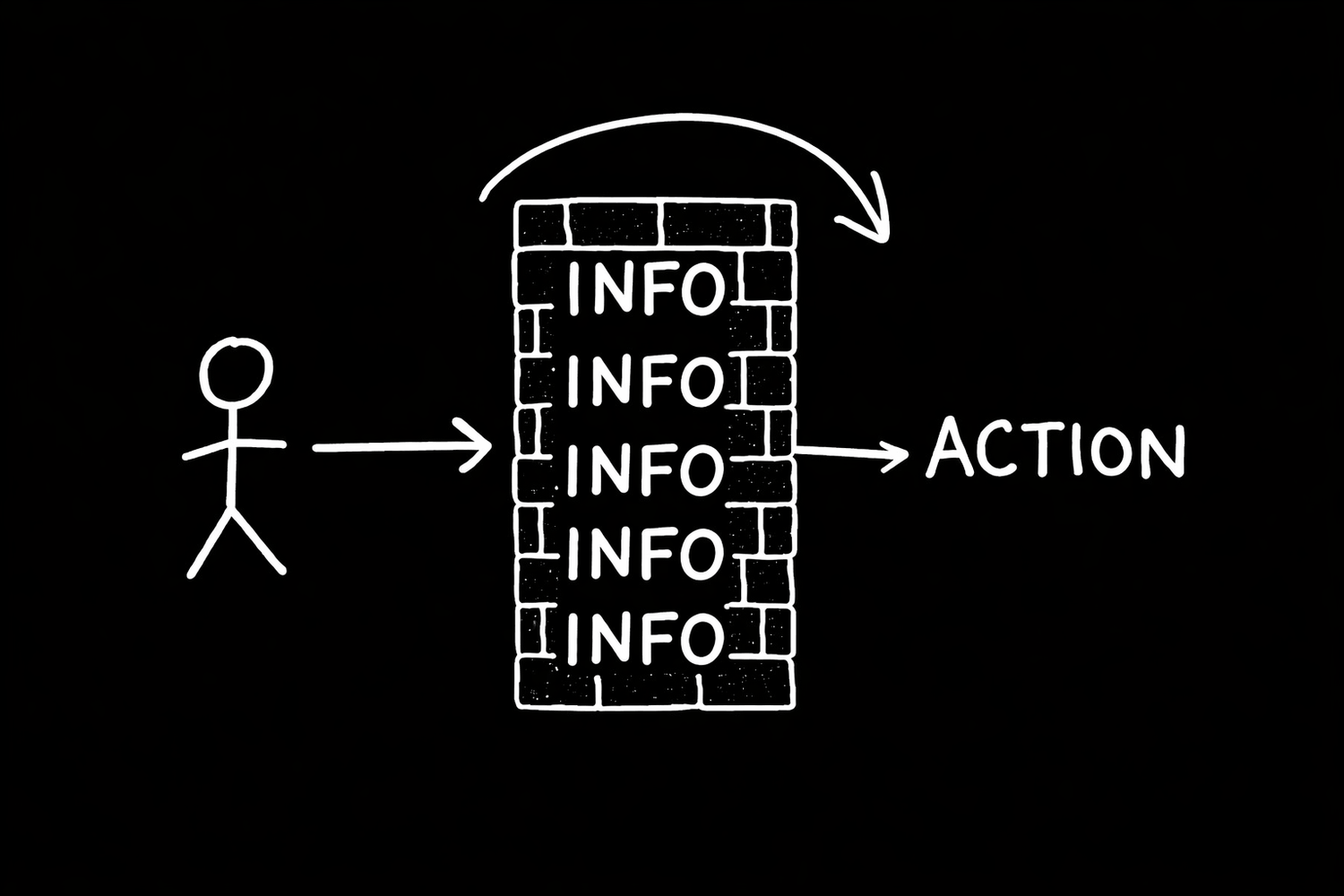
So you stay stuck… in this information gathering stage.
But most people believe they’re stuck because they lack knowledge…
When in reality, they’re using knowledge to avoid exposing themselves through action.
What does that mean?
Most people believe that they need more information before they start something.
This can be anything from exercising, starting to date, or more commonly, in my opinion, starting a business.
But why do people feel this need?
There are a few possible reasons:
Uncertainty: If there are instructions for the task that are unclear, it can make the task feel more unpleasant. So because people try to avoid these negative emotions, they procrastinate.
Complexity or Confusion: People usually put off tasks when they are confused by their complexity.
Analysis Paralysis: This happens when a person is overwhelmed by “choice overload” or having too many options to choose from. This leads to a state of indecision where they feel they cannot proceed.
Fear of Failure: Starting a task without feeling fully prepared may trigger a fear of failure of judgement. Avoiding the work serves as a psychological protection against the possibility of not doing well.
Because of these reasons, people avoid taking the necessary actions needed to progress.
People don’t avoid action because they lack knowledge.
They avoid action because it makes them feel something they don’t want to feel.
I mean it makes sense…
Why would you want to feel fear, feel judgement?
Simply: To grow.
Being Uncomfortable To Grow
To progress, evolve, or improve, people have to move past short-term mood regulation (the habit of avoiding tasks that cause a strong dislike to feel better in the moment), and focus on long-term achievement and well-being.
Training the mind and body to prioritize these challenging tasks can lead to significant improvements in your professional and academic lives, as well as mental health.
Why is taking feared or avoided actions necessary for growth?
Adaptive Coping vs. Avoidance: To effectively reduce stress and evolve, it’s recommended to use adaptive coping strategies. It’s kinda like approaching and taking action to change a situation rather than avoiding it. Avoiding a feared task may provide temporary relief, but it may also cause the stress and negative emotions to return or even increase.
Gaining Mastery: In the context of treating depression and low self-esteem, there’s an approach called “behavioural activation.” It’s kinda like scheduling activities that provide a sense of mastery or accomplishment. This signals that the act of doing the work itself is what builds confidence and skills.
Weaknesses as Opportunities: One way to progress is to recognize personal weaknesses not as shortcomings, but as opportunities for improvement.
Empathy for the Future Self: Evolution requires developing empathy for your “future self.” When people avoid a task they’re afraid of, their “present self” benefits from not doing the work, but their “future self” pays the price, possibly in increased stress and potential failure.
Building Self-Efficacy: Taking action is essential for developing self-efficacy. Self-efficacy is the belief in one’s capability to successfully complete tasks. This confidence is gained through actual performance accomplishments — proving to yourself through experience that you can handle the task.
Achieving Potential: Imperfect action is generally better than no action. That’s because the longer you delay, the more likely you are to do nothing at all. The ability to move forward with the understanding that mistakes will definitely happen is a key part of refining one’s approach over time.
What does delaying progress look like?
It can be:
Telling yourself you need more information
You open another tab
You watch another video
You take more notes
You still don’t move
Just to name a few.
There are all these positives to pushing through when it gets a little hard, yet, we tend to delay growing and evolving in order to feel better in the moment instead of benefiting in the future.
Intention-Action Gap
Let’s talk about the intention-action gap.
It is a core mechanism of procrastination.
It’s defined as the voluntary delay of an intended course of action, despite knowing that the delay will likely cause future suffering or worse outcomes.
Research shows that procrastinators usually intent to work just as hard as non-procrastinators, but they fail to follow through on these intentions.
This gap often widens the further ahead a person plans.
For example, a student may have strong intentions to study a week before exams, but as the deadline approaches, their original intentions can suddenly change as they pursue more immediate, smaller rewards like socializing or entertainment.
I’ve been meaning to lose weight for a long time now.
Over the past 6 years, I’ve put on and gained about 60 lbs.
During this time, I’ve been working out on-and-off, attempted to lose weight on-and-off…
But nothing stuck long-term past 6 months.
Most recently, just before my wife and I got married, I wanted to lose weight because I knew we would take photos and these photos were going to be plastered on ours and our family’s living areas forever.
I planned for it (not giving myself enough time, and I should’ve known better), but with the deadline approaching, it wasn’t going so well.
All that got put on hold when my wife-to-be, 3 weeks before our wedding day, got a Sickle Cell crisis.
This forced us to be in the hospital for the entire time.
But, my wife’s a fighter, and stubborn when we wants to be, and we left the hospital 2 days before our wedding, got ready, and got married on our wedding day.
Point is, I used the hospital visit as an excuse to not continue with my plan to lose weight.
I could’ve just stuck with eating the little amount of hospital food given to her daily (she hates hospital food), but instead, took the time to eat Tim Hortons Timbits (doughnut holes) and chips and snacks from the hospital convenience store.
As for the photos?
I think I look like I have a big head, but my wife was the happiest I’ve seen her, and that’s all that mattered.
Since then, I’ve constantly had the intention to lose weight, but I kept saying tomorrow, next week, next month…
And each time, the reward and pleasure of eating what I wanted, when I wanted, outweighed my goal of losing weight.
One day, I stood on the scale and saw that I weighed 212 lbs!
This was the most I’ve weighed in my life.
Right then and there I decided, starting New Years, I’m losing weight.
Prepared myself, and since January 2, 2026, I’ve been slowly losing weight.
I’m down about 20 lbs.
Slow… but steady. And that is more important than fast and unstable.
Emotional Avoidance
At its heart, procrastination is not a time-management problem, but it turns out, is a self-regulation failure rooted in a poor ability to manage difficult emotions.
Mood Repair: People often “give in to feel good,” choosing short-term mood regulation over long-term goals. If a task triggers negative states like anxiety, boredom, or stress, an individual may avoid it to find immediate relief — also known as mood repair.
Avoidant Coping: Procrastination is a form of maladaptive avoidant coping. That’s when you “hide” from a task to to make an unwanted mood, like anxiety, go away. While it provides temporary relief, it often leads to a “downward spiral” where the returned stress is even higher than the original task-related anxiety.
Coping Depletion: In high-stress contexts (like the pandemic), someone’s coping resources can become depleted, lowering their threshold for tolerating negative emotions and making them more vulnerable to avoiding tasks as a low-resource way to cope.
During my days working in international trade & sourcing, I was bored.
Now that I look back, that was such a good kind of bored…
Anyway, I totally forgot about this, but I got curious about real estate wholesaling.
It’s basically when you call up a seller (or their agent) and come up with a deal that is beneficial for both the seller and a buyer, for the buyer to purchase the property, and you make a commission when they do.
The commissions were less than in international trade, but there were definitely less scammers.
And the only reason I was interested in it was because it involved making deals just like in international trade.
There was a challenge I came across…
In international trade, I’m mostly messaging buyers and suppliers on WhatsApp or some other messaging platform, with the occasional video call if required.
But in wholesaling, it was all calls.
And that was creating so much anxiety for me.
So I understood everything: the deal structure, what to say, how to say it, the numbers involved…
And even after knowing pretty much everything I needed to know…
I still procrastinated for at least 2 weeks before I could make that first call.
So during the build-up of those 2 weeks, I was mood repairing, doing other things except the thing I had to do like creating Google Sheets for figuring out the numbers, attending the live calls to “learn” more, or creating a ChatGPT GPT to stump me during negotiations (which I won every time).
During that time, I was avoidant coping, hoping the anxiety and fear would go away before making the call.
When I finally made that first call, my coping depletion threshold was so low that I got the answering machine and leaving a message caused me so much anxiety that I couldn’t make another call for a few days.
I eventually got it to where I was able to text more than call, which made things a lot easier.
Fear & Perfectionism
Fear and perfectionism are psychological drivers that push people toward the drive to delay.
Perfectionism: For a lot of people, it is psychologically more acceptable to avoid a task entirely than to face the possibility of doing it poorly. Perfectionists will delay starting because they refuse to produce work with any flaws, effectively using procrastination as a protection against blaming themselves for it.
Fear of Failure: This involves the deep concern about the judgement of others. Procrastination can function as a form of self-handicapping — by delaying work until the last minute, the person can credit a poor result to a lack of time rather than a lack of ability. This would result in protecting their self-esteem.
Anxiety: Fear of being critisized or negatively evaluated creates a “habitual hesitation.” Interestingly, while some types of fear increase procrastination, others can eventually provide the “rush” or pressure some people believe they need to finally take action.
Although, I believe I’ve gotten over perfectionism, fear of failure and anxiety are still a big part of my life.
I’ve recently started writing these essays/newsletters.
And because I believe in just getting it done and publishing over getting it perfect and never publishing, perfectionism is not a thing I have to worry about.
But when it comes to fear of failure, I feel it when hitting that Publish button.
Because I do want these essays to help people.
I do want people to think for the better because of my essays.
And although I haven’t written anything serious like these — involving research and such — since school, the only way I can get better is by doing them consistently.
And just like school, I carry with me the habit of procrastinating with these essays.
Just like how in school I would wait until the day before, or the last minute, to finish my assignments…
Despite how much I want to work on it throughout the week, the weeks before this past have been a challenge.
This resulted in me spending about 10 hours each Sunday writing the entire essays.
And I guess this is a form of self-handicapping because maybe hiding behind the excuse of “not having enough time”, would make my self-esteem feel better if my essays don’t perform well.
This would be in addition to the anxiety I feel of being critisized negatively for my work, creating habitual hesitation.
This COULD also be the reason that I start and stay until I finish on the past Sundays because it gave me the rush or pressure I needed to complete it then and there.
So we know what can cause procrastination, delaying us from completing what is required to accomplish our tasks.
But what can we do so that we don’t hide behind the excuses of “more information” and “more knowledge”, so that we can get to the other side and take action?
How To Get To The Other Side Of The Info You Keep Collecting?
Taking action can be a challenging thing to do, especially to start it.
Especially if the intention-action gap is larger.
So here are a few things I’ve done — and one I’ve yet to do — to do the things I need to do to get the job done.
Step 1 - Decide
First and foremost, you have to decide to do it.
You can’t be iffy about it either…
You can’t just say “I’ll do it when I have the time tomorrow.”
You have to decide, right then and there, the more specific the better, “Tomorrow at 1pm…” or “Tomorrow after lunch, I will write the draft of my newsletter for 4 hours…” or “…until I finish my draft.”
Making that conscious decision is what will get you started, especially if it’s tied to your identity.
Every time I set out to lose weight, I remembered something I heard my mother-in-law said…
My partner, her mother, and I were standing in a line for something and the subject of me losing weight came up and how I lost so-and-so pounds in whatever weeks.
Then my now mother-in-law said something like, “Yeah, he’s very disciplined. He’s very good at losing weight when he sets his mind to it.”
I never saw it like that and ever since that day, that’s been a part of my conscious identity.
So when I set myself up to start losing weight in the new year, I remembered that and that helped me get started.
If you’re someone who is disciplined when they wanna be…
Or if you’re someone who really focuses on their goal when they set one…
Or if you’re someone who is stubborn when it comes to not giving up on things…
Use that identity to your advantage.
Step 2 - Mentally Prepare
I think mental preparation is underrated.
People may decide to do the task and just not feel like doing it.
Or they decide and do it, but be in a bad mood about it the whole time.
But for me — and I’ll use my January weight loss as an example again — I mentally prepared myself for it.
I’ve put on and lost weight so many times in the last 6 years alone, I know what to expect of myself…
And if I’m not in the right frame of mind to do it, I’ll either half-ass it or be miserable the whole time.
Kinda like what happened in January 2025.
I wanted to try out the carnivore diet, as a way to lose weight and save money (as it usually went for me).
And because my cousin in Korea was successful with it and made a few YouTube videos explaining how he does it…
I decided to give it a try.
And since I didn’t know what to expect, except to lose weight, I didn’t give it much thought.
So day 1 started and I scrambled 10 eggs with butter and some melted mozzarella cheese.
It was going good for a couple days, then something that’s never happened to me happened…
By like day 3, I felt SUPER… maybe depressed was the feeling?
I felt very unmotivated to continue…
I felt very down in the dumps…
Food didn’t excite me…
It was boring…
Just… not very pleasant.
I even tried to change from scrambled eggs to boiled eggs.
Probably about a week or 2 in, I decided I couldn’t continue on feeling the way I did.
Maybe if it was something like steak and eggs or something — something I’d enjoy — I could’ve done it.
But it was something I visibly didn’t enjoy doing and it was miserable.
For January 2026 though, I put myself in the right frame of mind:
I knew what I was going to eat…
I knew I would enjoy it…
I knew what I wasn’t going to eat…
I knew when I wasn’t going to eat…
I knew it would be challenging at first, but my body would eventually adapt.
And now, in April, I’m 20 lbs down.
My first milestone was to be able to fit into my favourite jeans.
When I wore them at 205 lbs, tell me why I couldn’t even button them up…
Not only that, they just were SUPER tight on me.
T’was a sad day…
But now I can fit in them!
Being a digital marketer and promoting weight loss products in the past, I truly understood what the phrase “be you again” means now.
Anyway… think it through:
What you’re going to do
What you’re not going to do
Where you would do it
Where you won’t do it
When you would do it
When you won’t do it
Why you’re doing it
It’ll help you a ton.
Step 3 - Control Your Environment
This one’s pretty simple.
Make sure your surroundings are in the correct state to accomplish your task.
When I’m about to do deep work on my newsletter, I make sure a few things:
Turn off all notifications - It’s true what they say, it’s very rare that an emergency comes up, and even if it does, there will be ways to reach you. I turn off all my notifications EXCEPT I allow all notifications from my wife. Even with that, it’s very rare that she’ll need me because of the next point…
Tell my wife I’ll be busy - I tell my wife I’ll be busy for the next few hours. This prepares her to do things that won’t involve needing to talk to me, so she’ll put on her headphones, play music, and play her games. This gives me the focus time I need to complete my newsletter, whether it’s the outline, the draft, or actually writing the whole thing.
Sounds - When it comes to sounds, I do either a couple of things. I’ll either have my earphones in my ears playing some feel-good classical music or… I’ll just leave my earbuds in my ear and have as much silence as I can. This allows me to tunnel vision on my task more.
Basically, I want to remove as much distractions as I can from my task of writing my newsletter.
It doesn’t have to be always about work though.
It can be doing chores, for example:
You’d probably want to blast some music.
Have all the lights on full.
Maybe have something on the TV in the background as company.
You set how you want your environment to be, how you feel you’ll accomplish your task.
Step 4 - If-Then Planning
This is something I want to do but I think I’ll need to build up to it.
I say “build up” to it because it requires some specifics.
If-Then planning is when you create highly specific “If-Then” plans for obstacles.
I’m usually pretty good about not getting distracted, but it’s best to prepare for it.
I like the saying “It’s better to have it and not need it, than to need it and not have it” and it’s appropriate here.
For example, I could have it so that:
If I get the urge to check my phone… Then I’ll go on X and post something instead.
If the music I’m listening to is distracting me… Then I’ll work in silence.
If I feel unfocused… Then I’ll take my focus meds.
If I feel restless… Then I’ll go for a walk.
Like I said, I’ll have to build up to it because I’ll have to see what situations come up, and if it happens, set a “then” for it.
I think it’ll be good to have but if you feel that it’ll restrict you too much, then you should probably not do it.
Better to be free to do your task than to feel restricted and confined.
Step 5 - Take One Step At A Time
Finally, whatever your task may be, take it one step at a time with behavioural activation.
Research shows that this is a highly supported strategy to break up large jobs into achievable chunks to build a sense of mastery and accomplishment.
It’s also recommended, to make it even more effective, commit to “tiny first steps.”
You can do this by working for just 2 minutes.
This helps reduce task aversiveness, which refers to any task you perceive as unpleasant, boring, frustrating…
So it’s subjective, basically meaning it depends on each person — what is aversive to an introvert may be enjoyable to an extrovert.
Sometimes, my wife is in too much pain to cook dinner, so I have to cook.
I worked in multiple kitchens in the past, so cooking is not a big deal for me.
But sometimes, I don’t wanna cook.
But I have to cook.
So what do I do?
Take it one step at a time.
How do you eat an elephant? One bite at a time.
So I start with a small first step; depending on what the meat is, cooking the rice: measure it out, wash it, put it in the rice cooker.
Once that’s done, it just gradually leads to the next thing.
Depending on time, I’ll either chill until the rice is done (or almost done), then probably take the meat out of the fridge, put some jerk marinade on it or something, and put it in the air fryer (if it’s wings or drumsticks or something).
If it’s not rice, then it’s heating the oven for fries (or just dump them in the air fryer).
Those are quick ‘n easy dinners.
Whatever the task, there’s always something you can start for 2 minutes.
Back to the chores example: You can start by soaking the dishes, then loading them into the dishwasher. If it’s vacuuming, then start by clearing the floors so things you don’t want sucked up the vacuum don’t get sucked up, then vacuum.
If it’s something like a newsletter, you can start by outlining it first.
Eventually, after you finish that, it would lead to the next thing, then the next thing, then the next thing.
It’s so much more important that you start more than anything.
Not researching.
Not gathering more information.
That’s not doing the work.
Doing the work is doing the work.
Remember, the action you keep avoiding is on the other side of the information you keep collecting.
Stay in touch
I write occasionally, when something feels worth sharing.
Occasionally, I write something worth sending. No noise.