
Why Getting Motivated Is the Most Dangerous Part
Picture this...
You find a new opportunity online...
“This is the one!”
You get excited.
You get hyped.
You get motivated...
You decide to go for it.
You do it for a month or so...
Then the novelty fades.
It’s not as exciting anymore...
In fact, it’s getting boring and repetitive.
Then one night, you’re doom scrolling...
And find a new opportunity!
“This is the one!”
And the cycle repeats.
Or how about...
You say you’re gonna get back to working out...
You hype yourself up...
You get amp’d.
You’re motivated...
You do it, and it’s awesome!
You’re getting bigger...
You’re getting stronger...
After about a month or 2, you notice you stopped getting bigger.
It’s getting boring.
Life gets in the way....
You skip one work out...
Then 2.
Pretty soon, you stop going all together.
Months later, you decide you need to start working out again.
The cycle repeats.
Or even this...
You meet someone new.
“They might be the one!”
It’s new!
It’s exciting!
You’re motivated to pursue this relationship.
You’re in the honey moon phase.
Life is sweet.
Then the honey moon phase passes...
You start noticing things:
They’re taking the relationship too slow…
There’s no physical or emotional chemistry...
It starts to get boring...
So you do what you normally do: You end it.
Then for some time, you do you; minding your own business...
Then BAM!
You meet someone.
“They might be the one!”
And the cycle repeats.
What do you notice about these common scenarios?
Besides the fact that they’re repeating cycles, they start because because of motivation.
So why, when we get motivated, are we so pumped to do the thing we set out to do, only for us to stop?
And if that’s the case, why do we “wait until we’re motivated” to do ANYTHING?
I Wasn’t Motivated, I Was…
Let’s take me, for example...
I’m in my room, in bed, as I type out this newsletter.
But I’m constantly thinking the weather’s warming up so I gotta start working out soon.
I have this whole plan ready when it starts warming up:
Sign up to the gym
Get back to my old sleep schedule at 10pm
Wake up early
Walk 30 minutes to get to the gym
Work out every day
Cold shower
Walk back from the gym
Eat
Work
The weather’s been warm for a couple days now.
I’m not sure how consistent it is, but do you think I’ve made the effort to sign up to the gym yet?
Nope.
I tell myself the same thing I’ve been telling myself every time I stop working out for a long period:
“Let me get motivated first.”
I’m sure you’ve said it to yourself plenty of times as well -- I can’t be the only one.
But why do we do that?
Why must we “get motivated first?”
And after we ARE motivated, it passes and we stop what it was we were motivated for in the first place?
It’s the same reason why when I tried to make money online back in 2018, I was motivated, then stopped....
But when I started back in 2021, there’s no stopping in sight.
Why I gave up the first time but stuck with it for good the second time around.
I was motivated back then.
This time around, I wasn’t motivated...
I was HUNGRY.
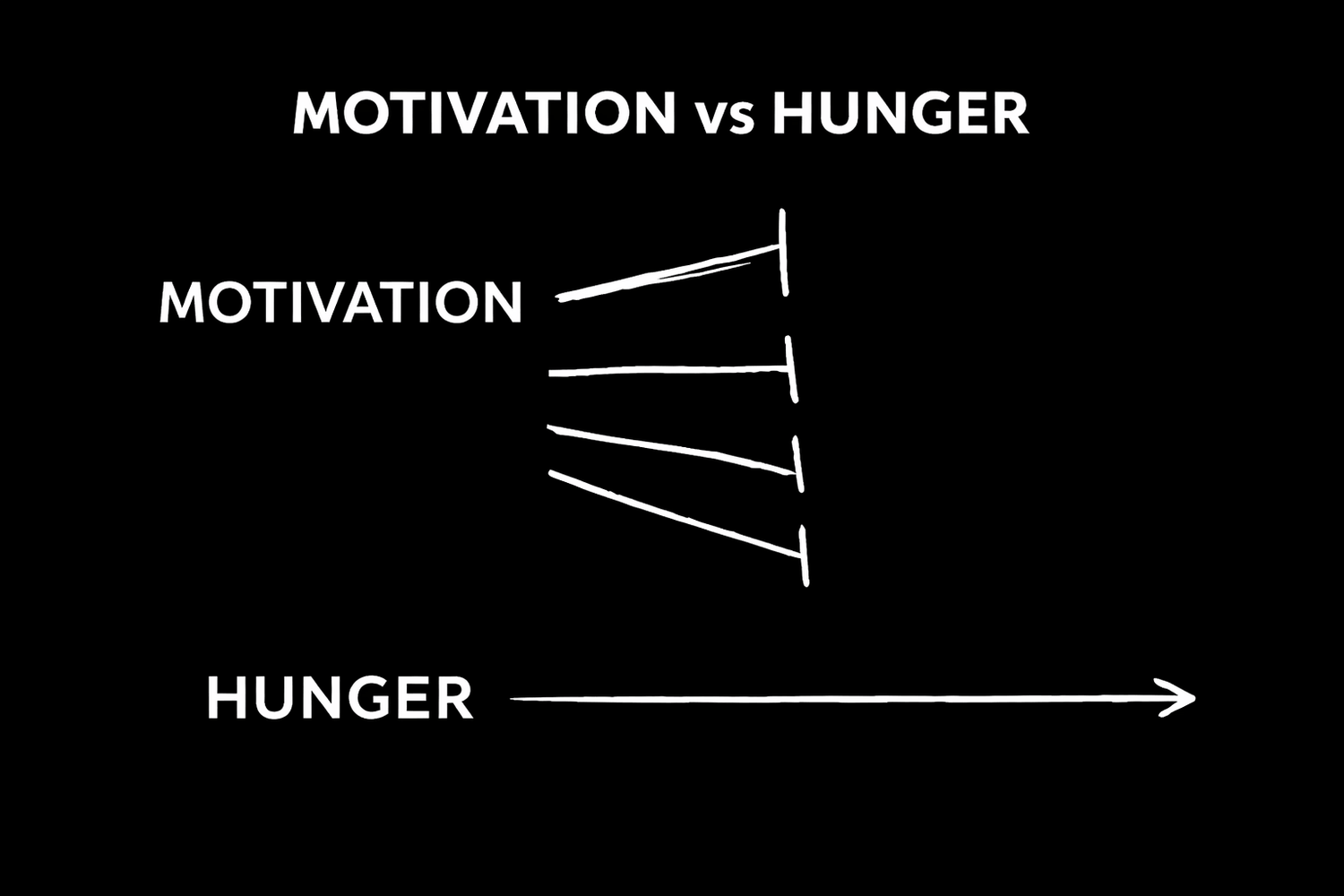
What Is Hunger?
Hunger is definitely not motivation.
Hunger is an identity-driven force that causes you to pursue and stay in pursuit of a goal.
You don’t pursue the goal because you’re motivated, you pursue the goal because pursuing that goal is who you made yourself to be.
It’s a part of your identity.
Which is part of the 4 things that determine hunger.
1. Hunger is tied to identity
Motivation says:
“I want to do this”
Hunger says:
“This is who I am”
Tony Robbins (a very well-known coach and motivational speaker) pushes identity shifts hard:
“This is who I am”
Hunger isn’t just desire…
It’s self-definition under pressure.
What do I mean by that?
Everyone has an idea of who they are:
“I’m someone who builds”
“I’m disciplined”
“I don’t quit”
“I’m trying to be consistent”
Most of these are soft identities.
They only hold when things are easy.
But pressure is the true test.
Pressure can be when:
You’re tired
Results aren’t showing
You feel doubt
You want to stop
This is where the difference shows up.
Motivation-based identity (what most people have)
“I want to be consistent”
“I’m trying to build something”
Under pressure:
They negotiate
They delay
They restart later
This is because their identity isn’t locked in yet.
It’s optional.
Hunger-based identity
“I’m someone who finishes what I start”
“I build, whether I feel like it or not”
When pressure hits:
Stopping creates friction
Quitting feels wrong
Not taking action conflicts with who they are
So they move and act accordingly.
Not because they feel like it, but because not moving breaks their identity.
These are so different.
2. Hunger comes from pain + desire
Tony Robbins is well-known for saying that people (or animals) are either moving away from pain or moving toward pleasure.
What does this have to do with hunger?
Hunger shows up when both are strong at the same time.
For example:
You are motivated when the fear of being poor drives you to take action
You are motivated when the excitement of earning $1M drives you to take action
With only the fear of being poor, other fears could pile on top of that like the fear of change.
This would stop you dead in your tracks.
With only the excitement of $1M, other excitements could pile on top of that like the excitement of lying on the couch watching the game or Netflix.
This would also stop you dead in your tracks.
But if you were to have both the fear of being poor and the excitement of earning $1M working with you to drive action, that can be hunger.
Hunger is when the pursuit of a goal is more desirable than staying the same.
Hunger is when staying the same hurts more than changing.
That’s not hype, that’s pressure.
3. Hunger doesn’t need reminders
Motivation needs:
Videos
Quotes
Music
External triggers
Hunger doesn’t need any of that.
It’s like my relationship with working out.
When I start working out, it’s purely for motivational purposes.
Before I go to the gym or even to our living room, I need to pump myself up.
I need to listen to the right music.
Or overall just to get myself in the headframe to workout to begin with…
I need to watch a Marvel movie for that super hero energy or anything badass like Lone Survivor.
I’ll probably need the weather to be nice and warm if I’m going to walk to the gym.
If it’s cold or snowy, you can forget that.
If you were truly hungry, nothing and nobody needs to tell you to make moves or take action.
This is obviously a shift I have to make in order to be consistent with my physical health…
But learning about myself in this way is a big step in getting me there.
There will have to be some major changes, but I’ll have to slowly implement them as time goes.
No music? Tough... I’m working out anyway.
Not feeling pumped? Aw well… I’m working out anyway.
No sun and it’s piss pouring rain? I’m shit outta luck… I’m working out anyway.
You don’t negotiate with hunger, you act.
4. Hunger overrides comfort
Motivation collapses when:
You’re tired
Distracted
Uncertain
Hunger ignores all of that.
Just this past Tuesday, I was in pain as I slept.
I was aching all over…
In and out of sleep all morning….
I could hardly get out of bed.
I didn’t know what was wrong with me.
I couldn’t even think about posting on my socials.
My wife wanted me to take me to the hospital.
I definitely wanted to be sure I was NOT going to the hospital.
So in the hospital emerge, I was given a couple of Advils.
I had taken Tylenol and the equivalent of Aleve at home and they barely helped me.
After 3-5 hours at the hospital, the doctor told me I had Myalgia.
The fuckin’ flu.
So there I am, at the hospital, because I got the flu of all things…
IV in my arm, body aching, posting like it’s any other day.
Robbins ties this to standards, not feelings.
People with high standards act regardless of mood
People relying on motivation wait until they “feel ready”
I didn’t feel like posting.
I didn’t feel like working.
But basically, fuck my mood, the moment I get the chance, I’m working.
The Difference Between Motivation And Hunger
In order for me to tell you the difference between motivation and hunger, I feel that I need to first tell you about the Self-Determination Theory (SDT).
What is the SDT?
Basically, it’s a framework for understanding human motivation.
It was developed by these two psychologists: Edward Deci and Richard Ryan.
To put it simply, their research states that people don’t stick to things because they’re motivated.
They stick to things when they feel internally driven.
Motivation is external:
“I should do this”
“I’ll get a reward”
"People expect this from me"
This works short term, then it dies.
Hunger is internal:
“I want this”
“This matters to me”
“This is part of who I am”
This keeps going without needing reminders.
The SDT also states that there are 3 internally driven forces that actually make people do stuff:
1. Autonomy (Choice)
This just means:
“This is who I am”
You’re not:
Being forced
Being pressured
Doing it just for the rewards
Because when you feel like it’s your choice, you’re more likely to keep going.
Let’s take Rocky Balboa for example — More specifically, Rocky IV.
— Some Spoilers —
Here’s this boxer who goes through the unfortunate event of his best friend dying in the ring at the hands of Ivan Drago, a deadly Russian boxer who came to the US to fight Rocky.
Now, he had a choice to make: Grieve his dead friend and leave it alone, or fight Drago — but on HIS home turf: Russia (Which I’m pretty sure was still the USSR in the movie)
He made his choice and throughout the rest of the movie, he trained and trained and trained his ass off.
And so I don’t spoil the ending for you if you haven’t seen this awesome classic of a movie…
He went on to fight Drago in front of thousands and possibly millions of hostile Russians. (Not sure if it was televised or not)
He made a choice — his choice — and had the hunger (or the eye of the tiger carried over from the 3rd movie) to do it.
He didn’t quit when he had to train without any sophisticated equipment.
He didn’t quit when he had to train in the icy, snowy mountains of Russia.
He didn’t quit when his fear got to the better of him and doubted himself.
He wasn’t going to stop until he knocked this fucker out.
— End Spoilers —
Don’t like that example?
How about a real example then?
Take the most dangerous boxer in history: Mike Tyson.
He grew up a troubled youth and by the grace of God, was taken in by his trainer: Cus D’Amato.
Cus ingrained in young Mike, since he was 15, that he could one day become the Heavyweight Champion of the World.
Mike had a choice: Continue his life of degeneracy, or train his ass off to become Heavyweight Champ.
Fortunately for all of us, he chose the latter.
And Cus trained Mike’s ass off.
Years later, Mike Tyson was set to fight Trevor Berbick for his first heavyweight belt.
But sadly, Mike didn’t have his father-figure of a trainer, Cus, witness this long-awaited moment.
Cus unfortunately passed away due to pneumonia a little over a year prior.
So without his long-time trainer by his ringside…
And armed with, not the motivation, but the HUNGER to succeed…
At 20 years old…
Mike Tyson became the youngest Heavyweight Champion in boxing history.
If Cus was still around, he would’ve been so proud.
Another driving force behind his victory, by the way…
It meant a lot to Cus, so it meant a lot to Mike.
Which leads us into the second driving force:
2. Relatedness (Connection)
This means:
“This matters to me or connects to something I care about.”
That could be:
People
Purpose
Identity
Something meaningful to you
If it feels pointless, you won’t stick with it.
Here’s a movie AND real life example…
According to the movie, The Pursuit of Happyness…
— Some Spoilers —
Chris Gardner was an average father and husband.
He made an investment into selling this machine for doctors.
It was called a bone density scanner.
On paper, this was a good investment.
He would sell these machines to doctors and since they cost a lot, he would get a lot back in return.
There was only one problem:
It was only slightly better than an X-ray. But much more expensive.
Doctors thought it was unnecessary and expensive.
So Chris struggled to sell them.
That was his life until he saw a stockbroker coming out of a Ferrari one day and Chris asked him:
“What do you do and how do you do it?”
That question changed Chris’ whole life trajectory.
From that point, he made a choice: To become a stockbroker.
So he applied for an internship. A tough one.
Out of 20 interns, only one would get the job.
So Chris worked his ass off.
During that time, Chris was going through a rough home life: His wife divorced him; he left the house with his son; stayed at a motel; got kicked out of the motel; stayed in shelters, churches, and wherever he could get in for the night… rough.
And even after all that, Chris was determined to get that stockbroker job.
Chris was determined.
He had a dream.
He had a purpose: To provide a better life for himself and his son.
He was HUNGRY.
His lowest point in the movie was not being able to find a place to stay one night and ended up locking himself and his son in a subway washroom, holding the door shut when people tried to get in.
But his internship wasn’t going so bad.
One day he managed to sneak his way up to getting an interview with a high level executive to manage his funds.
He missed the opportunity, but Chris changed his approach.
He ended up going to the executive’s house with his son and got invited to a football game.
There, he wasn’t able to sign the high level executive because he learned that Chris was just an intern…
But there were others that Chris networked with. connected with, and got business cards from.
After that, few more series of unfortunate events happened to him here and there.
And I’ll end it there in case you haven’t seen the movie, cuz… spoilers.
— End Spoilers —
Chris had a connection to his goal.
He attached meaning to it after he made the choice to pursue it.
And during the time at the internship, he knew that his time wasn’t being wasted because he knew he was getting better every day.
Which leads us to the third driving force:
3. Competence (Getting Better)
This means:
“I feel like I’m improving.”
Not:
Confused
Stuck
Constantly failing with no progress
If you feel like you’re getting better, you stay engaged.
If you feel lost, you quit.
Back in 2018, I didn’t have these.
That was when I first wanted to start making money online.
I had finished the audiobook “Rich Dad Poor Dad” that I downloaded for free from YouTube.
I can’t remember what made me do it, but then I went on my laptop with the Google search that changed my life forever: how to make money online?
I went down a deep rabbit hole of so many different things:
Trading stocks
Forex trading
Bitcoin trading (early!)
(I promise it wasn’t all trading stuff)
But I can’t for the life of me remember what else I found back then…
But you have no idea how lucky we are right now being in the age of information…
There is SO much info on this stuff compared to back in 2018.
It was almost hidden secrets I had to uncover to find anything about it.
But I was so motivated…
I was excited finding out this brand new world that was living right under my nose.
And being unemployed with family breathing down my neck about getting a job…
I instead decided I wanted to trade foreign exchange (forex).
And one day I turned $200 into like $1,800 I think it was?
It was either $1,800 or more, but point is, it was a big win for me.
Then, this is where my shiny object syndrome started happening…
I learned about other things I could do online, like making websites and such.
I won an increase of 800% of my money trading forex putting 100% of my focus on it.
Now, my focus was split.
Between forex trading, doing something with websites, watching webinars here and there, learning more things…
I was slowly losing money in my trading account.
I was essentially gambling away the money I had left…
Until my account zeroed out.
You could tell my mindset wasn’t right for trading back then.
So I let go of trading and focused more on the other things I was doing…
Until I got scammed.
Not once, but twice.
This all left a bad taste in my mouth and I quit because of it.
So what happened?
I was so motivated…
Then because of a couple of hiccups, I quit?
Motivation is external.
I wanted it for the money. I wanted the reward.
I wasn’t doing it for myself, I wanted to get my family off my back about being jobless.
I wasn’t hungry.
Fast forward to 2021.
I had just met my now wife almost a year and a half prior and we were talking about our future a lot.
Being unemployed again but due to the pandemic…
I needed to make some money if I wanted to make our future dreams into a reality.
Among the many things I dabbled in, forex trading was one of them… again.
But this time I had a better mindset about it.
I didn’t start trading my real money, only traded demo accounts until I could make money consistently (which is how it should be done).
And I thought I was improving.
Then one day, I was scrolling through TikTok and someone mentioned something I kept hearing about.
It was a 15 Day Challenge.
Wasn’t interested before, but maybe it was because it was a few days before my birthday, I decided $7 was nothing (which was probably more like $10 Canadian).
That eventually made me choose to invest in the $2,500 program (which was about $3,200 Canadian).
And that kicked off the journey I’m currently on right now, 5 years later: Posting written content, here and on my socials.
Constantly tracking what’s working for me, what’s not.
Doing more of what’s working, doing less of what’s not.
This way, I’m not confused and I’m not lost.
This is one thing that prevents me from quitting out of frustration again.
But during the journey here, there were SO many changes in direction…
So many restarts…
So many start overs…
So many hurdles and hiccups…
And through all of that…
I’m still on my journey with no quitting in sight.
Why?
Why is this time so different from the last?
I’m hungry.
I made my own choice.
I put meaning behind it.
And I’m constantly tracking to see my improvements.
The SDT states that people didn’t fail because they lacked motivation…
They fail because:
They don’t feel in control
They don’t feel meaning
They don’t feel progress
So they stop or quit.
You don’t stay consistent because you’re motivated.
You stay consistent because it feels like your choice, you see progress, and it actually matters to you.
You stay because you have the hunger to see it through.
The Hunger Framework
It took me almost 5 years to get to this point.
It wasn’t only until recently I found what I was meant to do and go all in on it. (By which I mean the exact method)
If I knew what I know now 5 years ago, I would be so much further along.
But instead, I had to constantly try something new and fail at it, try something new and fail at it, over and over, until finally I found something that stuck.
If you also find yourself in this same pattern, I created an audit for you.
This audit helps you identify the exact loop, triggers, and thought patterns that keep pulling you off track so you can stop starting over and finally build momentum.
If you’re wondering how anyone can do that: To go from motivated and quitting to hungry and pursuing, here’s a framework you can follow that is psychology-based, for the most part.
Stop trying to “get” hungry
Replace chasing feelings with defining stakes.
Hunger shows up when:
Staying the same costs you something real
Not acting has consequences
Most people try to hype themselves up — like me when I used to work out.
That’s fine to do, but if you’re constantly having to get pumped but end up quitting anyway, all of that is for nothing.
But real change happens when doing nothing becomes more painful.
2. Turn “should” into “must”
Replace optional goals with non-negotiables.
If it’s optional, it’ll slowly fade away.
You don’t need to guess here:
“I should post” dies
“I must build this or I stay stuck” moves
If you have an interest in something, whether or not you want to take action on it is always going to be optional.
Kinda like a “oh, that’s nice.”
If you make a commitment, that’s a promise to yourself that you’ll stay with it no matter what.
It doesn’t have to be done perfectly every day…
But as long as it’s attempted to be done on more days than none, that’s no longer an option, that’s a choice.
3. Make it yours (Autonomy)
Replace borrowed goals with chosen direction.
From SDT:
If it feels forced, you won’t stick
People quit because they’re chasing goals they don’t actually want.
You hear and see it often.
There’s the Asian kid who’s parents know nothing except outdated: go to school, get good grades, become a doctor or lawyer…
And once the kid is in University, or even worse, once he’s halfway through medical school, decides they’ve taken the wrong path in life just to make their parents happy… about THEIR life.
So they quit.
Hunger can’t exist in borrowed paths.
4. Build visible progress (Competence)
Replace vague effort with trackable improvement.
People don’t lose motivation randomly…
They lose it when:
They don’t see progress
They feel stuck
As I heard Alex Hormozi say, “If you don’t track, you don’t care.”
“I’m working hard” is never enough.
You have to know where you’re improving, where you’re dropping…
Make adjustments…
Take the top 10 best, take the top 10 worst
Figure out what the best had that the worst didn’t
Do more of what the best had
Take the top 10 best
Figure out what they did best
Do more of what the best had
Etc.
Progress needs to be obvious because if you can’t see the progress you’re making, your brain will think nothing is working.
If your brain thinks nothing is working, it will stop investing effort.
Visible progress confirms that your actions matter, which keeps you going.
Without it, your path feels pointless and you quit.
5. Tie it to identity
Replace doing something with becoming someone.
If it’s just an activity, you stop.
If it’s your identity, you continue.
It’s the difference between “I’m trying to build” and “I’m someone who builds.”
Identity removes the negotiations.
Why?
Because once something becomes a part of who you are, not doing it feels like breaking yourself, not just skipping something.
There’s no need for a debate or “should I?” because the decision’s already been made.
Identity turns action from a choice to the default.
6. Remove monthly restarts
Replace cycles with continuity.
This is where most people live…
They:
Start strong
Lose it
Restart
Not because they’re lazy…
But because they were running on motivation.
Motivation creates cycles because motivation depends on how you feel, and feelings change.
This causes you to start strong when it’s high, then stop when it drops off.
Hunger creates continuity because hunger isn’t based on mood, it’s tied to something you decided matters… no matter what.
So you still get the strong start when it’s high, but when it drops, the action doesn’t.
If restarting is an issue for you, check out my Restart Pattern Audit here.
It shows you why you keep quitting right before things start working.
You’ll uncover your restart type, your trigger moments, and the patterns that make you switch paths so you can finally stay with one long enough to see results.
Stay in touch
I write occasionally, when something feels worth sharing.
Occasionally, I write something worth sending. No noise.