
You May Be Stuck In This Loop & Not Even Know It
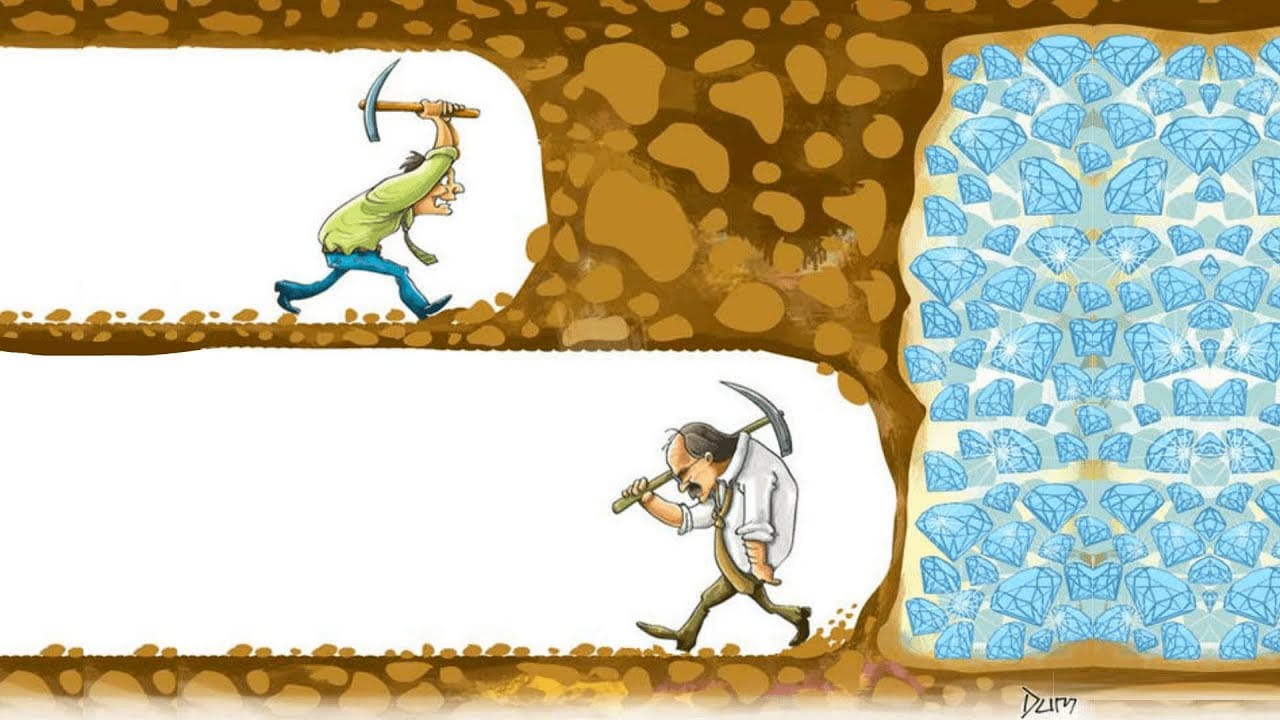
Do you know that image of the 2 diggers?
One digs and digs and JUST before he was about to reach the treasure, he quits.
But the other is is enthusiastically digging towards the fortune.
Of course, we all want to be the enthusiastic digger. The one who will get to their goal.
But a lot of the time, we are in a loop of being so close, yet so far. Stuck in this repeat of doom.
The loop doesn’t repeat because we are weak.
It repeats because you keep going back to the start right before things would’ve worked.
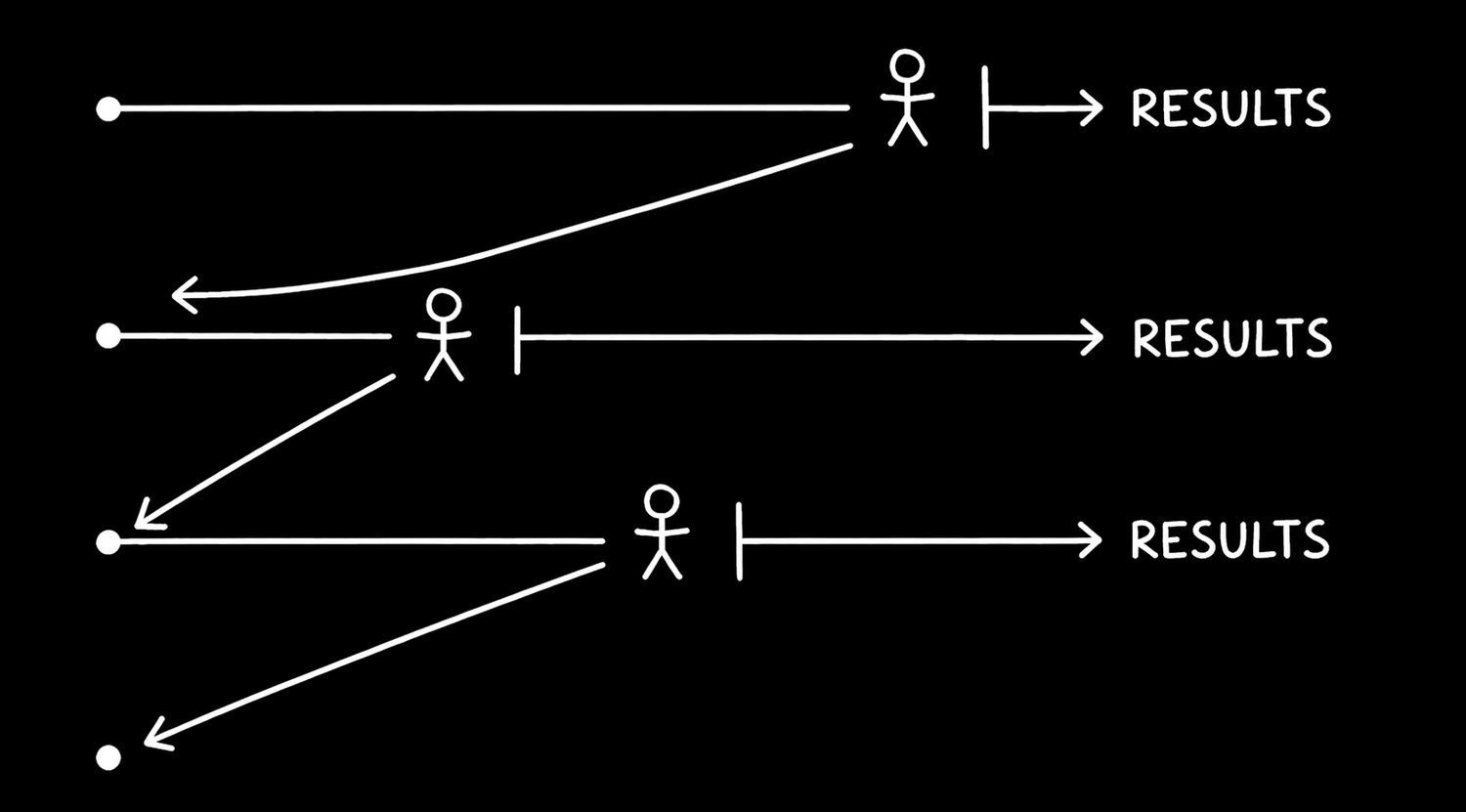
Repeating habits tend to have repeating feelings:
“I’m stuck again”
“Nothing is really working”
“This feels like the last time I tried this”
“I don’t want to waste more time on something that’s not going anywhere”
“I keep ending up in the same place no matter what I try”
These are beliefs that may be keeping you stuck.
But of course, let’s say these are beliefs you believe.
And at the time, that is what you’re used to believing.
How else are you supposed to look at it?
It is so important, first, that you must know: It feels the same every time in the beginning — so you assume it’s not working — And you stop before anything actually has time to work.
I feel that another important note is: You think you’re in the middle, close to the end, when in reality, you’re still WAAY back in the beginning.
The Timeline
A few years ago, back in 2021, I started my online business journey.
I invested in a course that taught how to promote other people’s products using TikTok and other short-form video to promote them and getting a commission when people buy.
One of the worst things in all my 5 years that happened was…
I started to see results in about 3 weeks.
“Results” in my case was getting 20k followers on TikTok and my first few commissions.
You might be wondering how that could possibly be a bad thing?
Let me explain…
Getting results as fast as I did really fucked up what I call my Timeline of Success.
This is the imaginary timeline of how long you think it would take you to be successful at a thing.
To make a long story short, I’ve been hopping around business model to business model for the past 5 years until recently where I’ve fixed this destructive habit.
If you’ve noticed you have this same problem of “restarting,” even when things were actually working, grab my free one-pager here for a short breakdown of why.
So because I kept jumping from thing to thing, every time I started something new, I always expected to get results within a month or so.
Whenever I didn’t, I would think I was doing something wrong or there was something I didn’t know.
This would result in me quitting too early and moving on to the next thing.
I never knew at the time that that made me never give anything I tried enough time to work.
I always thought I was close to my big breakthrough, when in reality, I was all the way back in the beginning of my journey.
And it turns out, this is way more common than I ever imagined.
Why Is This Behaviour So Common?
Quitting too soon is a widespread phenomenon because human psychology is often wired for self-preservation, immediate gratification, and the protection of one’s public image rather than long-term perseverance.
Quitting is something nearly everyone does at some point — giving up on diets, workouts, side projects, careers, studies, and relationships.
What separates successful people from the rest isn’t intelligence or talent, it’s how long they’re willing to persevere — how long they’re willing to keep going and keep moving forward.
Here are a few possible reasons why people quit too soon:
1. Biological Misinterpretation of Discomfort
Because of evolution, humans are wired to avoid discomfort because it once signaled danger rather than opportunity. When a task becomes challenging, the brain enters a “self-preservation mode,” comparing the struggle with failure. This “effort threshold” — the point in a new task where the initial “easy gains” disappear and the work becomes genuinely difficult — causes the brain to translate slow progress or confusion as a signal to back down, leading people to mislabel temporary discomfort as proof that the effort isn’t worth continuing.
2. Impression Management and the Fear of Embarrassment
It turns out, the desire to maintain a positive public image frequently outweighs the motivation to succeed. I guess that’s true because people would rather go broke looking successful than actually working to be successful. Or people who face high external expectations — like being the “favourite” in a competition — are statistically more likely to quit after an early setback to avoid the embarrassment of failing publicly. Quitting becomes an “exit strategy” or a form of self-handicapping — where people create obstacles for themselves to avoid the embarrassment of failing because of lack of ability — allowing the person to maintain the story that they could have succeeded had they continued.
3. The “What-the-Hell Effect” and Self-Recrimination
The what-the-hell effect is a pattern where a single minor slip-up downward spirals into the goal being totally abandoned. This is where quitting can also come from. Most people mistakenly believe harsh self-discipline and “tough love” are the best ways to stay on track. But research shows shame is a terrible long-term motivator and can lead to avoidance. When someone misses a single day of a routine (which happens to everybody), the feeling of self-blame and that the “streak is broken” happens which leads them to give up entirely instead of just returning to it the next day.
4. Short-Term Misconceptions of Success
Many people quit because they expect a direct link between effort and results in the short-term. Which is a rare occurrence. Because results are often lagging indicators, which means today’s results are because of habits from months or years ago. People become discouraged when their immediate hard work does not produce instant returns. Additionally, the brain’s reward system favours immediate feedback. This makes it difficult to defend continued effort for goals with delayed rewards.
5. Failures in “Recognizing and Returning”
In daily life, persistence is occasional rather than continuous — meaning goals are repeatedly restarted. Many people don’t quit because they made the decision to stop. They quit because they fail to recognize new opportunities to pursue the goal after something comes up like a busy week or illness. Or they could fail to return to the task because of distractions like their phones or loss of focus. Without a specific plan for how to handle these inevitable slip-ups, a temporary pause can often turn into a permanent stoppage.
The Building & Tearing Down
In the past 5ish years, I’ve attempted multiple business models.
One of them was short-form video content creation.
I’ve done faceless brands and using my face as the brand.
Particularly, I would post on TikTok because I had the belief that I could go viral faster.
But TikTok seems to have given me a lower effort threshold than, say, Instagram, that doesn’t have an effort threshold at all.
I noticed when I would start a new TikTok account and post the first 1 or 2 videos, they would get decent views — at least 500+.
But after that, if your videos suck like mine did, you’d get stuck in the 200s.
I noticed Instagram doesn’t have that.
When your videos suck, you get 0 views from day 1.
I have a faceless TikTok account that at its peak, was probably ~60-65k followers or something.
I made the mistake of completely abandoning the account when it was bringing in about $100+ a week.
I could’ve grew it from there, but something happened (I don’t remember what) that made me stop.
Anyway, I attempted to revive this account earlier this year and was posting 3x per day, every day, for maybe a month or 2.
It wasn’t going anywhere.
And it discouraged me from continuing.
It first started with missing one or two posts.
Then it turned into missing a whole day.
I made up my mind already, but it was hard letting go — it felt like such a waste; it still had 55k followers.
Eventually I just stopped posting on it altogether because I found it to be just a waste of time that I could be using better elsewhere.
This was the what-the-hell effect in action.
If I had more care for it, I would’ve done everything I could to improve my performance, get every video better and better, have the right things to say, and gradually grow it more.
I did not give myself and the method enough time to do all that.
Had I give it my full focus and attention, give it at least 3-6 months, and improve every day, it would’ve worked out.
But there were some key lessons that I should’ve known then that I know now…
3 Key Lessons To Know That Causes Quitting Too Soon
These lessons will help you be more aware of what’s going on so that you don’t get yourself stuck in the same loop of starting, quitting too soon, starting something new, quitting too soon, again and again.
I not hoping that knowing these will be enough, but what you do with this knowledge should be enough to at least make you aware of what’s going on so that you can make the right decisions on how you want to proceed.
Lesson 1: It’s Going To Feel The Same At The Start
At the beginning of any pursuit, there is often a disconnect between the energy you put into something and the results you get.
This is known as the effort-success misconception.
This is the false belief that the more effort you put in the sooner the results you get.
But if that were the case, then every person who works out on the first day would see results that very first day.
If you know anything about working out, you’d know that if anything, you’d actually feel worse after the first day and more sore.
Once you enter the effort threshold of a pursuit, your brain will mistakenly confuse slow results with wanting to pull out of the pursuit.
This is a biological response that makes you feel as though all the hard work you put in is failing, all because discomfort arrived before reward.
Lesson 2: That Doesn’t Mean It’s Not Working
Research shows that visible success is almost always a lagging indicator.
It’s because of the persistent effort you put in for the past few months to years that you’ll finally be able to see success.
Persistence often requires a shift in mindset where you to focus on the process instead of focusing on the outcomes to overcome the effort-success misconception.
It’s better to focus on:
Each work out instead of having the big muscles.
Each day you’re together with your partner instead of being old together.
Each post instead of thousands of followers.
I’d even argue that having both in mind may be better.
Focus on the process for persistence and focus on the outcome to keep the hunger alive.
Just because the “applause” of the final goal hasn’t come yet, doesn’t mean things aren’t going to work in the background.
Lesson 3: The Difference Only Shows Up If You Stay
The real benefits of a pursuit only happen through consistency over time.
This results in the decrease of efforts to achieve results.
Staying with the goal results in learned industriousness — where psychologically, those rewarded for their persistence learn the value of effort itself.
This wires the brain to tolerate higher levels of discomfort, resulting in self-handicapping prevention.
This way, you stop making excuses to quit early for fear of embarrassment.
Success is described as “extraordinary results coming from ordinary actions performed consistently.”
If you manage to stay and fight through the periods of no results, no returns, no rewards…
You’ll eventually reach a breakthrough point where your past energy, time, and effort finally pay off.
Stay in touch
I write occasionally, when something feels worth sharing.
Occasionally, I write something worth sending. No noise.